


Key takeaways
- A detergent rash (contact dermatitis) and eczema look similar: red, inflamed, itchy skin. Location tells the real story.
- Eczema usually appears in the crook of the arm, behind the knees or on the face. A rash limited to skin under clothing, especially armpits and groin, is a reason to ask about a patch test.
- Itch that gets worse when you sweat doesn't point to detergent on its own: sweat itself is a common eczema trigger.
- Check the label for three common allergens: methylisothiazolinone, SLS and fragrance.
- Detergent is blamed more often than it is guilty. See a doctor or dermatologist: patch testing is how you find out, and if it points to a detergent ingredient, choose a formula without it.
You wake up scratching. You have a red, bumpy patch on your stomach or the back of your neck. You assume it's dry skin or maybe an eczema flare-up. You apply lotion, but it doesn't help.
It's tempting to blame your laundry detergent. Detergent is one possible cause of a rash like this, but it gets blamed far more often than it turns out to be guilty.
Occasionally, what looks like eczema is allergic contact dermatitis, a reaction to something that touches your skin. In a multicenter study of 738 patients with dermatitis, only 0.7% reacted to laundry detergent on patch testing. Patch testing by a dermatologist is how you find out what your skin is actually reacting to.
Laundry Rash vs. Eczema: What's the Difference?
Visually, they look similar: red, inflamed, itchy skin. But the cause and location tell the real story.
1. Location Patterns
- Eczema (Atopic Dermatitis): Usually appears in "flexural" areas: the crook of the arm, behind the knees, or on the face. It is often genetic and flares with stress or weather changes.
- Detergent Rash (Contact Dermatitis): A rash confined to skin covered by clothing, especially high-friction areas like the armpits and groin, is a reason to ask a dermatologist about a patch test. Even then, the fabric itself is a more likely culprit than leftover detergent.
2. The "Sweat" Trigger
Does your itch get worse when you work out? That doesn't point to your detergent on its own: the National Eczema Association lists sweat itself as a common eczema trigger. A dermatologist can help you work out which one you're dealing with.
The Top 3 Itch-Inducing Ingredients
If you suspect your detergent is the problem, check the label for these three common allergens:
- Preservatives (Methylisothiazolinone): This preservative was named "Allergen of the Year" by the American Contact Dermatitis Society. It has been reported in some laundry detergents, though usually at levels too low to cause reactions.
- Surfactants (SLS): Sodium Lauryl Sulfate is a known skin irritant that can strip your natural lipid barrier, leaving skin raw and vulnerable.
- Fragrance Mixes: Fragrance is one of the most common causes of allergic reactions to cosmetics and personal care products.
Why "Rinsability" Matters More Than "Gentleness"
Marketing tells you to buy "Gentle" detergent. We'd tell you to buy Clean-Rinsing detergent.
The good news is that little detergent stays behind after a normal machine wash: a 2025 dermatology review concluded that detergent residues on machine-washed clothes are not clinically significant, even for very sensitive skin. If clothes still smell sour after washing, that's a different problem, covered in our guide to the sour, persistent odor in your clothes.
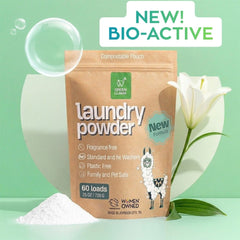
What we'd use
NEW - EWG Verified™ Max Strength Fragrance-Free Laundry Powder (60 Loads)
Green Llama Laundry Powder is designed to be fully soluble. No deposition aids. Just clean fabric. Our Max Strength Fragrance-Free Laundry Powder is free from masking agents, synthetic perfumes, optical brighteners and harsh dyes, and a 60-load pouch is $19.95, about 33 cents a load. Green Llama makes this product.
Shop NEW - EWG Verified™ Max Strength Fragrance-Free Laundry Powder (60 Loads) →Green Llama makes this product.
How to Treat a Detergent Rash
If you are dealing with a rash right now, start with a doctor, not your laundry room:
- See a doctor or dermatologist. Treatment depends on the cause, and patch testing is how a dermatologist confirms an allergy. Go promptly if the rash is severe or spreading.
- Avoid what you react to. If a patch test points to a detergent ingredient, such as methylisothiazolinone or fragrance, choose a detergent without it and check every label.
- Double rinse. While you wait for answers, adding an extra rinse cycle to each load is an easy step.
The Simple-Label Standard
If you still itch after changing detergents, the cause may not be your laundry at all, which is one more reason to see a dermatologist. If a patch test does point to a fragrance or preservative, a short, fully listed ingredient label makes that ingredient easier to avoid.
To build a complete low-tox strategy for your clothes and home, start with our Home Detox Guide.
Quick questions
What does a laundry detergent allergy look like?
Visually, it looks a lot like eczema: red, inflamed, itchy skin. The location gives clues. A reaction to something in your clothes tends to show up on skin the clothing covers, especially high-friction areas like the armpits and groin, though the fabric itself is a more likely culprit than detergent. Eczema usually appears in the crook of the arm, behind the knees or on the face. A dermatologist's patch test gives the answer.
What ingredients in laundry detergent cause a rash?
Check the label for three common allergens. Methylisothiazolinone, a preservative reported in some laundry detergents, was named "Allergen of the Year" by the American Contact Dermatitis Society. Sodium lauryl sulfate (SLS) is a known skin irritant that can strip your natural lipid barrier. Fragrance is one of the most common causes of allergic reactions to cosmetics and personal care products.
How do you treat a laundry detergent rash?
Start with a doctor or dermatologist. Detergent is one possible cause of contact dermatitis, but it is blamed more often than it is guilty, and patch testing is how a dermatologist finds out what your skin is actually reacting to. If it points to a detergent ingredient such as a preservative or fragrance, choose a detergent without it. Go promptly if the rash is severe or spreading.
Sources
- American Academy of Dermatology. (2023). Atopic dermatitis: Signs and symptoms.
- National Eczema Association. (2025). Causes and triggers of eczema.
- American Academy of Dermatology. (2020). Contact dermatitis.
- National Eczema Association. (2025). Contact dermatitis.
- Castanedo-Tardana, M. P., & Zug, K. A. (2013). Methylisothiazolinone. Dermatitis, 24(1), 2-6.
- Lee, C. H., & Maibach, H. I. (1995). The sodium lauryl sulfate model: An overview. Contact Dermatitis, 33(1), 1-7.
- Smale, N. E., Karagounis, T. K., Milam, E. C., Cohen, D. E., & Flamm, A. (2026). Allergic contact dermatitis to personal care products: A focus on established and emerging allergens. Journal of the American Academy of Dermatology, 95(4), 1095-1102.
- Belsito, D. V., Fransway, A. F., Fowler, J. F., et al. (2002). Allergic contact dermatitis to detergents: A multicenter study to assess prevalence. Journal of the American Academy of Dermatology, 46(2), 200-206.
- Puch, E., Štulhofer Buzina, D., & Ljubojević Hadžavdić, S. (2025). Hypersensitivity reaction to detergents: A myth or reality? Acta Dermatovenerologica Croatica, 33(1), 42-43.
All guides in this topic
- Laundry Detergent for Sensitive Skin: How to Choose One That Won't Irritate
- Eco-Friendly Laundry Detergent for Babies & Newborns: A Parent's Safety Guide
- Is Your Laundry Room Causing Asthma? Hidden Irritants Exposed
- Is Your Laundry Room Making You Sick? A Home Detox Guide


