


Quick answer
Most DIY laundry recipes make soap, not detergent. When soap meets the calcium and magnesium in hard water, it forms soap scum, a waxy, insoluble residue. Instead of washing dirt away, it builds up on your clothes and inside your washing machine, leaving fabrics dingy, towels stiff and odors trapped.
A quick scroll through Pinterest or your favorite eco-friendly blog, and you're bound to see it: a simple, three-ingredient recipe for homemade laundry detergent. It usually involves a grated bar of soap, some washing soda, and maybe a little borax.
The appeal is undeniable. It feels frugal, wholesome, and free of mysterious chemicals. You get to control exactly what's going into your washing machine. What could be better?
We love that spirit. It's the same drive for transparency and simplicity that fuels us at Green Llama. But as scientists and formulators, we have to be honest about something crucial: most DIY laundry recipes aren't actually making detergent.
They're making soap. And while that sounds like a minor detail, it's the key to why your homemade efforts might be leaving your clothes dingy, stiff, and coated in a funky residue.
For how loose powders, pods and sheets compare, see our laundry showdown: detergent sheets vs. pods vs. powders.
The Big Problem: Soap vs. Detergent
Here's a little kitchen-sink chemistry lesson that will change how you see laundry forever.
- Soap is made from fats or oils combined with an alkali (like lye). It works great for washing your hands.
- Detergent is built on synthetic cleaning agents called "surfactants" instead of true soap.
The critical difference? How they react with water. Many homes have "hard water," which is high in minerals like calcium and magnesium.
When soap molecules meet hard water minerals, they bind together and form a new, waxy, insoluble substance. You know it by its common name: soap scum.
Instead of lifting dirt and washing it away, homemade laundry soap often creates this residue, which then builds up on your clothes and inside your washing machine.
The Unseen Damage of DIY Laundry Soap
You might not notice the buildup at first, but over time, that soap scum can cause a host of problems:
- Dingy, Grayish Fabrics: The waxy residue traps dirt and grime in the fibers of your clothes, making your whites look dull and your colors appear faded.
- Stiff, Scratchy Towels: That buildup makes fabrics feel rough and less absorbent. Your once-fluffy towels can become stiff as a board.
- Funky Odors: Residue left in the fabric may hold on to body oils and sweat, which can leave a lingering smell, even in "clean" clothes.
- Washing Machine Buildup: That same residue can build up inside your washer over time.
In short, your effort to get cleaner clothes could actually be making them dirtier over time.
A Note on Borax and Washing Soda
Let's talk about the other two common ingredients. Washing soda (sodium carbonate) is great; it's a mineral ingredient widely used in detergents and cleansers. We're big fans.
Borax, on the other hand, is more complicated. While it's a naturally occurring mineral, it's not without concerns. The Environmental Working Group (EWG) warns that borax can irritate skin and eyes and has raised concerns about hormone disruption. For a brand obsessed with safety, it's not an ingredient we would ever use.
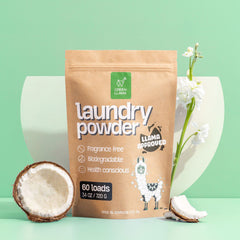
What we'd use
Powerful Fragrance Free Laundry Detergent (60 Loads)
Our everyday laundry powder pairs saponified coconut oil with washing soda (sodium carbonate), the mineral water softener we're big fans of. It's low-sudsing for HE machines and free from synthetic fragrance, optical brighteners and PVA film. One tablespoon cleans a standard load: $13.95 for 60 loads, about 23 cents a load. Green Llama makes this product.
Shop Powerful Fragrance Free Laundry Detergent (60 Loads) →Green Llama makes this product.
The Modern Detergent Solution: Smarter, Not Harsher
So, if DIY soap is out, what's the answer? It's not going back to the giant plastic jug. It's choosing a professionally formulated, science-backed detergent that delivers a true clean.
Modern eco-detergents are designed to solve the exact problems that DIY recipes create:
- They are made for the machine: low-sudsing, and formulated to lift and remove dirt in all water temperatures.
- They contain chelating agents (like sodium gluconate), which grab onto hard water minerals and prevent them from interfering with the cleaning process. No soap scum!
- They use enzymes to target and break down specific stains like grass, blood, and oil.
You're getting all the benefits you sought from DIY, no harsh chemicals, no synthetic fragrances, no plastic waste, but with the scientific precision needed for a genuine, deep clean. It's the best of both worlds.
Your desire for a simple, honest, and effective laundry solution is exactly right. You just need the right tool for the job. Instead of kitchen-sink chemistry, you deserve the peace of mind that comes from proven laboratory science. This is a core principle of our entire sustainable laundry routine.
Ready to trade the risks of DIY for a guaranteed clean? Discover Our Science-Backed Laundry Powder
Quick questions
Why is homemade laundry soap bad?
Most DIY recipes make soap, not detergent. Many homes have hard water, high in calcium and magnesium. When soap molecules meet those minerals, they bind together into soap scum, a waxy, insoluble substance. Instead of lifting dirt away, it builds up on your clothes, so whites look dull, colors appear faded and towels turn stiff.
Does homemade laundry detergent ruin your washing machine?
You might not notice it at first, but the soap scum homemade laundry soap creates can build up inside your washer over time. The same residue builds up on your clothes, so your effort to get cleaner clothes could actually be making them dirtier.
Is homemade laundry detergent safe?
It depends on the recipe. Washing soda (sodium carbonate) is a mineral ingredient widely used in detergents and cleansers. Borax is more complicated: while it's a naturally occurring mineral, the Environmental Working Group (EWG) warns that it can irritate skin and eyes. It's not an ingredient we would ever use.
Sources
- U.S. Food and Drug Administration. (2024). Frequently asked questions on soap.
- U.S. Geological Survey. (2018). Hardness of water. Water Science School.
- Environmental Working Group. (2016, May 18). Watch out for borax.
- Al-Ghanayem, A. A., & Joseph, B. (2020). Current prospective in using cold-active enzymes as eco-friendly detergent additive. Applied Microbiology and Biotechnology, 104(7), 2871-2882. https://doi.org/10.1007/s00253-020-10429-x
- National Center for Biotechnology Information. (n.d.). PubChem compound summary for CID 10340, Sodium carbonate. Retrieved October 21, 2026, from https://pubchem.ncbi.nlm.nih.gov/compound/10340


