

Quick answer
A dishwasher that leaves food on dishes usually has one of seven problems: a clogged filter, a crowded load, blocked spray arms, water cooler than 120°F, detergent that never left the cup, a cycle that is too light, or a detergent too weak for baked-on food. Check them in that order, starting with the filter in the tub floor.
The cycle's done, the door's open, and there's dried egg on a fork and something baked onto the casserole dish. Now you're choosing between rewashing by hand, calling a repair service and blaming the detergent. Most of the usual causes take minutes to check, and the first three cost nothing to fix.
This is the checklist, in the order I'd work through it. If you're here to pick a detergent, start with our guide to eco-friendly dish soap and dishwasher detergent.
Why is my dishwasher not cleaning dishes?
Usually water or detergent isn't reaching the food. Where the dirt is tells you where to look first.
| What you see | Most likely cause | Go to |
|---|---|---|
| Everything is dirty | Clogged filter, cool water, or detergent stuck in the cup | Causes 1, 4 and 5 |
| Top rack dirty, bottom rack fine | Something tall below is stopping the middle spray arm, or its holes are clogged | Causes 2 and 3 |
| Bottom rack dirty, top rack fine | A top-rack-only cycle was selected, or the lower arm is blocked | Causes 2, 3 and 6 |
| Detergent still in the cup | The dispenser door was blocked, or the detergent is old and clumped | Cause 5 |
| Only baked-on or dried-on food is left | The cycle is too light, or the detergent can't break it down | Causes 6 and 7 |
One thing that isn't on the list: rinsing your plates first.
You have to rinse dishes before they go in the dishwasher.
Scrape, don't rinse. ENERGY STAR says rinsing dishes before loading "increases the total water and energy used." Source
How to fix a dishwasher that's not cleaning: 7 causes in order
What you need: a soft brush, dish soap, a toothpick or paper clip, and a meat or candy thermometer.
- Clean the filter.It sits in the floor of the tub, under the lower rack. Bosch says to wash it "with soap and a soft brush under running water" (Bosch support). GE says its removable filters "should be cleaned once a month" (GE Appliances). Your manual shows how yours comes out. No manual? Search your model number on the maker's support site.
- Give the load some room.Whirlpool is blunt: "overloading restricts water circulation and leaves dishes dirty" (Whirlpool product help). Face dirty sides down and in toward the spray arms. Don't nest plates, bowls and silverware together (GE dishwasher FAQs). Then spin each spray arm by hand before you close the door, and rearrange anything it hits.
- Clear the spray arm holes.Bosch says to rinse the arms under water, then loosen debris in any blocked hole with a toothpick. GE suggests "a small object such as a paper clip or tweezers."
- Check that the water is hot enough.GE says water entering the dishwasher should be at least 120°F. Cooler water "can prevent automatic dishwasher detergent enzymes and tablets from fully dissolving" (GE dishwasher FAQs). To check, run the hot tap at the kitchen sink into a glass and read it with the thermometer. Use a heat boost option if your machine has one.
- See whether the detergent left the cup.A tab or clump still in the dispenser never reached the dishes. Move anything tall away from the dispenser door and use fresh, dry detergent. The next section has more.
- Choose a heavier cycle.GE says a short or light cycle "may not provide proper wash action for a heavily soiled load" (GE Appliances). Also check that you didn't pick a top-rack-only cycle, which doesn't run the lower spray arms (Whirlpool product help).
- Then look at the detergent.If only baked-on or dried-on food is still left, check the ingredient list for enzymes. The last section explains why.
Run the hot tap first
GE's trick: run the hot water at the kitchen sink for 15 to 30 seconds right before you press start. The machine then fills with hot water from the start.
If none of this helps, check that the water supply valve is completely open (Whirlpool). After that, GE's advice is to book a service visit.
Why is my dishwasher pod or tablet not dissolving?
Usually the dispenser door couldn't open, or the detergent is past its best.
- Something is in the way. A pot or pan loaded too close to the dispenser can get in its way (Whirlpool product help).
- The detergent is old. Whirlpool says older detergents exposed to air "tend to clump and dissolve poorly," which can make the dispenser door stick. Store it tightly closed, somewhere cool and dry.
- The water is too cool. Under 120°F, tablets may not fully dissolve (GE). See cause 4.
- A spray arm is blocked. Whirlpool says a blocked arm "can delay detergent release and soil removal." See causes 2 and 3.
A note on our own tabs: they're pressed with no plastic film, and one buyer's review says they can get crumbly. Our tabs page says to keep the pouch tightly sealed or move the tabs to an airtight container.
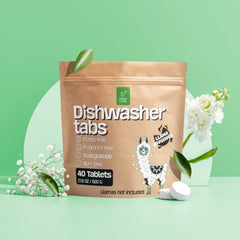
What we'd use
EWG Verified™ & PVA-Free Dishwasher Tabs
If the checklist points to your detergent, try these. They break down dried-on food like egg and rice, so it washes off. They won't fix a clogged filter.
Shop EWG Verified™ & PVA-Free Dishwasher Tabs →Green Llama makes this product.
Does the detergent matter for baked-on food?
Yes, once the first six causes are ruled out. Egg, cheese and meat leave protein behind, and rice and pasta leave starch. Enzymes are the ingredients that deal with those: proteases help remove protein-based food stains, and amylases remove starch-based ones (Naganthran et al., 2017).
That's why our dishwasher powder and our dishwasher tabs both list protease and amylase, plus oxygen bleach.
One tabs buyer had blamed the machine for years:
"We’ve hated our dishwasher for as long as I can remember. We’ve tried a variety of tabs, but since it still didn’t seem like it was cleaning dishes as well as we’d like, we assumed we had a bum dishwasher. THEN we tried the GL dishtabs. I literally gasped out loud when I opened the dishwasher after our first use - the dishes were visibly sparkling. BIG FAN!"
Erika B. · Verified buyer · Our dishwasher tabs
That's one household's experience, not a test, and a new detergent won't clear a clogged filter. That's why detergent is last on this list.
In 2025, Tandell Research, an independent lab, tested our dishwasher powder against a Cascade powder and a Cascade tablet on six standard test soils. Scores are approximate, out of 100.
| Soil | Our powder | Cascade powder | Cascade tablet |
|---|---|---|---|
| Baked cheese | About 96 | About 34 | About 84 |
| Spaghetti bolognese | About 97 | About 39 | About 97 |
| Egg yolk with milk | About 96 | About 32 | About 97 |
| Minced meat | About 96 | About 53 | About 95 |
| Corn and rice starch | About 86 | About 63 | About 69 |
| Tea | About 8 | About 6 | About 11 |
The Cascade tablet scored level with ours on bolognese, egg and minced meat, and its baked cheese score came with a wide margin of error, so we aren't calling that a gap. All three were weak on tea. This was our powder on lab test pieces, not our tabs and not a home kitchen.
Format is only part of it. Whirlpool recommends high-quality "pre-measured tablets and packs," but whichever format you buy, look for protease and amylase on the ingredient list.
Quick questions
Should you rinse dishes before putting them in the dishwasher?
No. Scrape off the food and load them. ENERGY STAR says rinsing first increases the total water and energy used, and GE and Bosch both say to scrape, not rinse. Bosch adds that detergent needs small food debris to cling to in order to work properly. Soaking is usually recommended only for burned-on or dried-on food, according to Virginia Cooperative Extension.
Why is my dishwasher not cleaning the top rack?
Most often something tall in the lower rack is stopping the middle spray arm, or the arm's holes are clogged. Spin the arm by hand before you start a cycle. If it catches, rearrange the load. If it spins freely, look at the holes and clear any blocked ones with a toothpick. Then check the filter.
Why is my dishwasher not cleaning the bottom rack?
First check that you didn't select a top-rack-only cycle. Whirlpool says that on machines with that cycle, the lower spray arms don't run, so the lower rack isn't washed. If that's not it, make sure nothing is blocking the lower spray arm, clear its holes, and clean the filter in the floor of the tub.
How do I clean my dishwasher filter?
Take out the lower rack and remove the filter from the floor of the tub. Your manual shows how yours comes out. Bosch says to wash it with soap and a soft brush under running water, and GE says its removable filters should be cleaned once a month. A full dishwasher clean is a separate job with its own steps.
Sources
- Bosch Home Appliances. (n.d.). Dishwasher not cleaning dishes.
- ENERGY STAR. (n.d.). Dishwashers. U.S. Environmental Protection Agency.
- GE Appliances. (n.d.). Dishwasher: Poor wash performance.
- GE Appliances. (n.d.). FAQs: Dishwashers.
- Grisso, R., Walker, M. A., & Ignosh, J. (2020, February 24). Energy series: What about dishwashers? (Publication 2908-9018). Virginia Cooperative Extension.
- Naganthran, A., Masomian, M., Rahman, R. N. Z. R. A., Ali, M. S. M., & Nooh, H. M. (2017). Improving the efficiency of new automatic dishwashing detergent formulation by addition of thermostable lipase, protease and amylase. Molecules, 22(9), 1577.
- Whirlpool. (2026, August 31). Detergent dispenser is not opening. Whirlpool Product Help.
- Whirlpool. (2026, June 29). Dishes are not clean. Whirlpool Product Help.
- Whirlpool. (2026, June 10). Spray arm not working: Dishwasher. Whirlpool Product Help.


